Public Health Just Got Personal


The CDC issued six health alerts in all of 2025, down from dozens in a normal year, whatever that means anymore.
Measles, a disease we basically eliminated 26 years ago, is closing in on 1000 cases, with children hospitalized for brain swelling. And the people now running our top health agencies are the same people who spent years questioning the science those agencies existed to defend.
But the good news is people are building new things. States are forming their own health alliances. Scientists are organizing to fight misinformation where it lives. And one epidemiologist in Texas turned a six-week email experiment in March, 2020 into one of the most trusted public health resources on the planet.
So what can I do about the collapse of trusted public health communication?
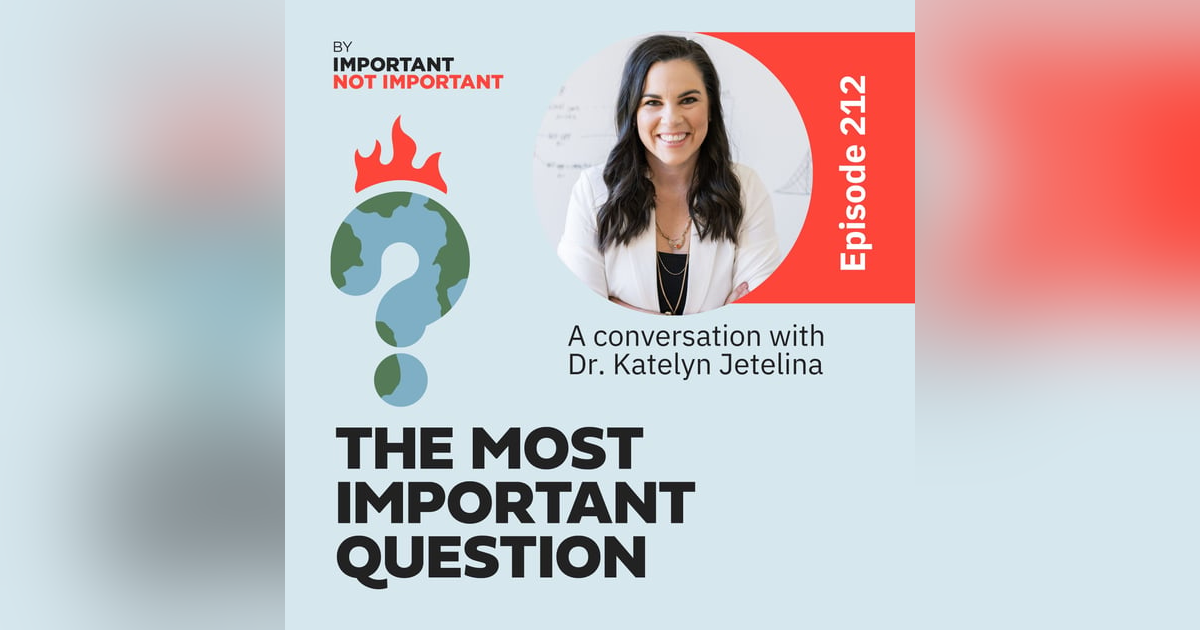
Today's guest is Dr. Katelyn Jetelina. Katelyn is an epidemiologist, a mom, a wife, a data scientist, and the founder of the incredibly popular Your Local Epidemiologist newsletter. It is free. She started it from our kitchen table, and it now reaches something like 310,000 subscribers in 130 plus countries. She's one of the Time 100 most influential people in health, former advisor to the White House and the CDC, and she now leads Project Stethoscope as well.
We're gonna talk about how Katelyn built YLE, why the old model of top-down public health communication was always broken and is now definitely broken, and what Project Stethoscope and Phoenix are actually doing about it.
-----------
Have feedback? Tweet us, or send a message to questions@importantnotimportant.com
New here? Get started with our fan favorite episodes at podcast.importantnotimportant.com.
Find every action recommended in The Most Important Question here: www.whatcanido.earth
-----------
INI Book Club:
- All The Shah's Men by Stephen Kinzer
- Find all of our guest recommendations at the INI Book Club: https://bookshop.org/lists/important-not-important-book-club
Links:
- Subscribe to Your Local Epidemiologist https://yourlocalepidemiologist.substack.com/
Follow us:
- Subscribe to our newsletters at importantnotimportant.com
- Join us at importantnotimportant.com/upgrade
- Get our merch!
- Follow us on Threads: www.threads.net/@importantnotimportant
- Subscribe to our YouTube channel
- Follow Quinn: on Twitter - twitter.com/quinnemmett; Bluesky - bsky.app/profile/quinnemmett.bsky.social; Threads - www.threads.net/@quinnemmett
- Produced by Willow Beck
- Intro/outro by Tim Blane: timblane.com
Advertise with us: importantnotimportant.com/c/sponsors
Mentioned in this episode:
Quinn: [00:00:00] The CDC issued six health alerts in all of 2025, down from dozens in a normal year, whatever that means anymore. Measles, a disease we basically eliminated 26 years ago is closing in on 1000 cases with children hospitalized for brain swelling. And the people now running our top health agencies are the same people who spent years questioning the science those agencies existed to defend.
But the good news is here, people are building new things. States are forming their own health alliances. Scientists are organizing to fight misinformation where it lives. And one epidemiologist in Texas turned a six week email experiment in March, 2020 into one of the most trusted public health resources on the planet.
So what can I do about the collapse of trusted public health communication? Well, every week I ask someone working on the front lines of the future, the most important question in the world. What can I do? I found out why they do the work and what you and I can do [00:01:00] to support it. I'm Quinn Emmett, and today's guest is Dr. Katelyn Jetelina. Katelyn is an epidemiologist, a mom, a wife, a data scientist, and the founder of the incredibly popular, Your Local Epidemiologist newsletter. It is free. She started it from our kitchen table and it now reaches something like 310,000 subscribers in 130 plus countries. She's one of the Time 100 most influential people in health, former advisor to the White House and the CDC. And she now leads Project Stethoscope as well, which we're gonna get into. It sounds super fun. We're gonna talk about how Katelyn built YLE, why the old model of top-down public health communication was always broken and is now definitely broken. And what Project Stethoscope and Phoenix are actually doing about it.
What you and I can do right now to protect our families and communities and help rebuild the systems we all depend on, for everyone this time. Let's go.
Katelyn. Welcome to the show. Where on earth are you today?
Katelyn Jetelina: Thanks for having me. I am in San Diego, [00:02:00] California. Yeah. I feel pretty lucky to be here, especially through this past winter that the Northeast seemed to not expect to get.
Quinn: Here's the thing. Good for you in San Diego. I was in LA for a long time. I get it. I felt the same way. I'm back on the east coast. I was born and raised. You know what? Screw the northeast. They were prepared for this. I am calling you from like above a candy shop in Colonial Williamsburg. Let me tell you who was not prepared for two inches of ice for like two months. These horses and carriages. Not great. Not great.
Katelyn Jetelina: Yeah.
Quinn: Well, I'm glad you joined. Do you ever get out on the waves? Do you surf amid trying to save public health?
Katelyn Jetelina: I do earn my zip code. I wouldn't say I'm a surfer, but I can get out there.
Quinn: There you go. It's the effort that counts. That's very exciting. One of my best friends on the planet is an anthropology professor out at San Diego State.
Katelyn Jetelina: Fish tacos and burritos. Yes.
Quinn: So good. My office mate who, childhood friend, he lived in La Jolla for a while and I was like, that's not a real place. I wouldn't get used to [00:03:00] that being, you know.
Katelyn Jetelina: That's fancy too.
Quinn: Well, it was like him and his fiance at the time, they're like babies. They had nothing else to do. Let's go back to something else that doesn't feel like real life before we get to what's happening now where people just generally dislike vaccines and prefer the measles. Let's go back to a moment to to, to get to the present moment.
Because you have had quite the trajectory. Let's say March, 2020. From what I understand, your boss is like, could you send some emails with some graphs to some colleagues about this new virus? And now you've got basically, you know, a million readers in every country and well, you don't advise this White House, but other ones that existed.
Walk us through sort of how you approach those early emails, when you realized this maybe deserves to become something much bigger and because this has happened to a lot of folks, and I think especially folks obviously in health and public health and medicine and all this. What did you have to give up along the way to [00:04:00] kind of scale this to where it is now? Get not all the way, but just like that early transition.
Katelyn Jetelina: Yeah, it's been a wild ride. It has been a wild ride. I started in, you know, I was a professor at the time in March of 2020. Just going up for tenure, actually. Really a young professor with a research lab and yeah, my dean asked me if I could update faculty, staff, and students and what the heck was going on.
I think she asked me one, because I used to work at the WHO in Geneva, so I had connections there looking at the data. I also love teaching. I love teaching, and so I was like, what the hell? Right. I'll just start doing this, you can go look back at those emails. They're pretty, pretty hilarious.
They're just like a few sentences long with these really ugly Excel graphs. And just explaining to people what was bringing them along for the ride. And also explaining what I was doing with my family at the time. I had a nine month old. [00:05:00] I was pregnant. My husband was a police officer. Not coming home.
I mean, it was just wild times. A few days later, one of my students came to me and was like, Dr. Jetelina, can you like, just please put this on social media so I don't have to keep copying and pasting it for my family and friends. And I distinctly remember turning to my husband and being like, you know what?
What the hell? I only have to do this for like six weeks max, and surely someone's gonna pick up the baton. And that never happened. And it just grew and grew and grew and grew. I just, you know, I fell into discovering this gap and I never, ever thought it would become this big thing and become my life's work honestly, too. I don't know when the time was when I was like, wow, this is gonna go on forever. I actually still think like tomorrow, no one's ever gonna wanna hear from an epidemiologist again, but that's just, it's just not been the case. If you look throughout the pandemic on interest in my [00:06:00] stuff, my growth follows the waves of the COVID-19 variance, right?
If you go back as like alpha wave increased it a little. Omicron just made me go viral. Delta increased a little, like, you know, it was just those waves. And ever since the end of the emergency it's been exponential growth. Like I said, never was gonna be a thing, but turned into a thing because by darn it, we need this. And it's a huge gap between institutions, scientists, and like people on the ground in the main battlefield of sediment.
Quinn: I think I found a quote somewhere where you said scientists are never taught how to communicate to the public, so we're catching up to influencers. But you know, my wife, who's the most amazing human in the world, she's an absolute nerd, which is great.
She went to Stanford, she tried in college is one thing that differentiates us. I went to Colgate, great little liberal arts school and you could always tell the really, really, [00:07:00] really smart professors who would often let you know that. And the best communicators. And who you would at least, I often felt like I have no business understanding of this and somehow this person helped me do that. It's obviously clear again, reading your work for all of these years now, and all the other people that do as well, and so many people trust you like, you, maybe you said you were never taught to communicate with the public, but with the WHO and working in Geneva, you've got something here.
People trust you. You founded the Evidence Collective. Imagine for a moment that a bunch of those wellness influencers were, for example, running the federal health agencies now, what is it like competing for trust against people who don't necessarily share your constraints around evidence and nuance and, and what is effective? It's hard to be on both offense and defense, right?
Katelyn Jetelina: Yeah, it is for sure. I mean, [00:08:00] one thing that's very clear this past year is public health is really good at defense. They are terrible at offense, but like what is it like to compare for trust? It's really challenging and I think especially now because we have such a saturated information landscape, I think that's also kind of an excuse not to get into the arena. What we're seeing right now is more of a symptom of something that's built up over 20, 30 years rather than the cause of where we are right now. I mean, there's a reason why, where the United States is like seriously thinking about having a wellness influencer as US Surgeon General, and there's a reason why RFK is HHS Secretary, the biggest anti-vax founder, and so, you know, I think that to me, sure it's easy to find a nemesis and be really angry and frustrated, but also it means we have to step up and do better. Internal [00:09:00] reflection is really hard for some people, and we just have to be honest with ourselves and catch up. We're about 20 years behind, I would say.
Quinn: I had again, three children under three. I mean, I still have them. They're just not three under three anymore. Talking about how we're 15, 20 years behind like this, our new affinity for measles did not start this year. Right. And like everything else. I remember my daughter, middle child, was a year and a half and we're in this like 1500 square foot house in LA and our third kid is born as my wife said, I already have a baby.
How can I have another baby? And my daughter gets whooping cough. And we didn't know from where, but you know, she's in like gymnastics groups and playgroups, who can know. And that's when you start to read about like the parents in the schools on the west side, theoretically claimed to be pretty liberal.
But we're outsmarting our doctors and we're gonna hold off on the, the sequence. And I remember the CDC called and they were like, [00:10:00] you have to basically split your house in half or your new baby will die, essentially. Because he was days old and you felt scared, but also taken care of in a way where someone was like, Hey, we're watching, and they called all of the time.
We're watching out for you. But also, like if you took a step back, it was clear. They were like, we also don't want this to go anywhere else, right? Like, there's relative herd immunity, especially in our part of town. But again, like there's babies and then there's other kids who don't. It's less of that way now, but vaccine hesitancy, I guess if we still wanna call it that is so prevalent And so top down now, and like you said, the information system is so saturated when you're approaching the newsletter twice a week and you've got the evidence collected on one hand. Right. How do you balance out, have you found a model for storytelling [00:11:00] versus like lecturing on evidence. Because the problem is, is like even the best meaning people don't necessarily open those emails all the time.
Katelyn Jetelina: Not necessarily the ones that you wanna reach to.
Quinn: Yeah.
Katelyn Jetelina: You know, storytelling is something I'm trying to get better at. It is incredibly uncomfortable for a scientist, scientist to story tell and one of the main reasons is that we're taught to take all emotion out of data, but that makes it like really boring to the rest of the world.
And it's a muscle that has to be strengthened. I do some storytelling. I've talked about my time at the WHO. I've talked about during the pandemic a lot about me being a parent at the time. In fact, that stuff went way more viral than when I was talking about a strain or something like that. A lot of storytelling, trying to strengthen that.
But also, you know, one thing that I have found to be really part of the secret sauce in[00:12:00] communication is the value of listening. So about, I would say about 80% of my content isn't necessarily what I think is important or interesting in the moment. It is the questions, concerns, and confusion that I am either seeing on social media or getting directly from my community, the YLE community that we've created.
One example I love to talk about is H5N1. So bird flu was all over the news. It's still spreading right now, but it was all over the news in like 2024. I was updating my newsletter of like, Hey guys, look at this crazy thing this virus is doing. It's jumping from cow to cow. It's this strain like.
And like usually when I, when I led with what I thought as an epidemiologist was interesting, it completely flopped because like no one really cared. They cared about what it mattered to them, and so I was like, what are people asking about this? So I went to Google Trends, it's a database, and I was like, okay, if people are Googling about bird flu, what are their [00:13:00] questions?
And it was things like, can my dog get this? Do I have to worry about my bird feeders in the backyard? If I'm hunting, what do I need to do if I pick up a dead bird? And like really simple, really necessary answers that people had questions to. And so I wrote up like those five questions, I was like, okay, these are the top five questions, that went viral.
Because it was just trying to meet the needs and the questions and concerns people were getting. The place we get in danger in science is we leave those information voids wide open and that's where mis and disinformation can fill it really quite easily. And so yes, I think storytelling is really important.
I also think as important or even more important, is that we need to listen better and when we listen better we can better meet people's needs. We build trust over time. We show value over time and people can see and feel it. [00:14:00] And that consistency and that connection is absolutely key.
Quinn: It's fun to nerd out and do those charts, but like you said, over time it's been six years and over so many readers in so many places.
And obviously, you know, a percentage will open it and a percentage will read it and a percentage will get back to you. But even in the way you titled the newsletter. It feels so personal to people that I imagine it makes them feel very comfortable responding, right and engaging and assuming that other people, most of the people there are engaging and reading for similar reasons because they are Googling, or I guess now GPT or whatever, similar things.
How is this going to affect me, what does this mean for my family and my dog and my kids' school? Like, holy cow, is it gonna close again like this and that. Good friend on, Dr. Nahid Bhadelia, a couple times, a few times over the years on the show about, I always, we always joke that whenever she comes on something, it's not great.
It's not for, it's [00:15:00] not for like fun in games. So we did a bird flu one when, like you said, like all that crazy shit was in the news. And I was like everyone is asking those questions. Unlike you, I am not, credentialed would, would be going so far, able to answer them in an informed way in any way. And so I always try to lean on folks who know what the hell they're talking about and she's really good about coming out and being like, this is the real deal.
This is how it might go. But we don't know. These are the signals, this is what you should understand, et cetera, et cetera. But it is really helpful to listen, right? Because eventually you can see people almost tuning out the rest of it. Right. And I don't know if that's because they feel so saturated or not, but where, how do you find the signals in your responses or where you see on newsletters? Are there, do you have other specific examples that kind of led you to Project Stethoscope? Where listening changed how you actually approached doing this?
Katelyn Jetelina: It's been my entire [00:16:00] journey in the beginning, you know, March, April, May of 2020, I would read literally every comment and every email that came to me because I really wanted to understand where people's heads were at. And what would be most useful. As it's grown, that's become impossible. We just get thousands of emails and messages, and I now have a team. So it was a one woman show and now there's about 15 of us at YLE. Now we're trying to systemize it and do a lot more direct engagement. So every Monday we're now asking the audience, Hey, we're gonna be writing about this topic.
What are your questions? So for example, tomorrow we're gonna be writing about school vaccination, or we already wrote about school vaccination requirements for kiddos and what are people's questions around that. So trying to make it a little more systemized is helpful. We also have data tools. Now we have social listening tools.
For example, yesterday, we saw this [00:17:00] huge spike in people Googling around seasonal allergies, and so I was like, oh, people are feeling this. Here we go. Let me cover it. It has to be relevant to people's lived experiences. It has to be timely. This is where institutions like when I was at CDC or what, we were so behind, we just couldn't move fast.
Like the bureaucracy fast enough for what people actually needed. That is a huge value of being outside of an institution. So there's the, you know, the Google data, the social media data. We're just asking human beings, asking the community. We're seeing environmental scans, like what's popping off in the news and how can we possibly relate public health to that? Right now, Iran, like there's so many health consequences to war, is that something we can fit in and be talking about? So it's really creating a bidirectional relationship with the audience, it's with people in the community. It's with people who we're trying to reach. [00:18:00] I hope people can feel that and see that it's been harder, the more topics that get thrown at us. COVID was actually really easy because it was just one topic that the whole world was following, but now it's like everything. But we're doing it and we're trying and I hope that people see that we're trying, ultimately humans trust humans. And so I really try to bring in that human voice.
I hope that people know there's a human on the other side. And there is someone that really genuinely cares and is fighting for them. Instead of fighting for institutions at this moment,
Quinn: Even if it is your job and you have a team of 15 now from a one woman show to, to that, all these credentialed, thoughtful, intentional people who are like, how can we help with this thing that we've built with so many people?
And yet. Again, 'cause we're so connected because so much is going on and is, we like to use the active voice being, being done to, to so many folks. It's one thing to be like, oh, yep, it's about time for cherry blossoms and allergies. [00:19:00] Another thing to constantly be responding to everything, right? I have a soccer chat group and a friend posted yesterday.
He is like, so what do people think of this peace prize that Trump got? And I was like, did you, are you just catching up on your email? Like, do you know how much has happened since then? Like, what are you talking like, we're past that buddy. We've moved on. It's impossible. Right? Like, he was so well intentioned, but I was like, my friend, scroll up, scroll way up. Like we're, we're, you can't, you can't do it. Your kids have grown up among you kind of completely changing course in your career here.
Katelyn Jetelina: My poor husband.
Quinn: My wife. I remember my wife at one point finding me like hiding under a blanket and she was like, you're gonna need to have to figure out a way to handle this job better if you're gonna want to do this. Because it's elective for you and not for other people. It's like good, good notes. Okay. So you've really like come into your own parenting through all this. Your kids have grown up with masks and no masks and, and you know, local and state public health getting shredded and all this different shit.
How do you think it's affected your parenting? How [00:20:00] do you think it's affected how you talk to other parents at pickup, drop off play dates, like all that shit because it has been a ride?
Katelyn Jetelina: It has, you know, I was actually, so I'm right now in California, but for 15 years and during the height of the pandemic, I was actually in Texas.
I will forever, forever be grateful I was an epidemiologist during the pandemic in Texas because it forced me on how to listen. It forced me to understand how policy isn't just driven by science, but it's driven by values and philosophy and culture and a little science, we hope so, but also like a collision of all of these things.
Texas is a really hard place to govern. It's kind of purple. They don't wanna say it's purple, but it is. And you have big, big cities and you have very, very rural and you have very different opinions about what evidence is. You have different opinions on overreach and autonomy. And [00:21:00] so just leading a response or helping lead a response in Texas as well as doing a newsletter is I actually gained a whole lot of empathy from people. To truly understand where people come from when, for example, they don't know if they should get the vaccine or not. Because does mRNA actually change your DNA and like that's actually a really good question.
Quinn: It's a great question. If you have nothing to go on, you're like, I don't know. Those sound a lot alike. Like I've seen Jurassic Park and that's what I have to go on here.
Katelyn Jetelina: And we do have some vaccines that can change your DNA in the pipeline at FDA, right? So it's not even unplausible. So I think that what have I learned? I mean, it's been being empathetic and so when I do talk to a parent, I actually don't shut down. I actually lean in when someone is like, Hey, can you talk to me about this?
This Orthodox Jew guy at the bar came up to me 'cause he heard my conversation and we just sat there for three hours. Talking about COVID and vaccines, [00:22:00] because selfishly, I can learn more about where they're coming from and have better communications.
Quinn: Yeah.
Katelyn Jetelina: And so, you know, and as a parent, I don't know, I mean, I don't know if I'm doing well as a parent. I mean, this is, I feel like we've been in, I've been in emergency mode for the past six years, which is their entire childhood. But I hope that they see that mom is, you know, trying to change the world for the better. I go on social media and I'm like. Shit. So like how much am I ruining their brain for giving them an iPad for an hour?
Like you just don't know. Like there's just so much, it's so hard to be a parent right now. And so I think that's where a lot of my empathy comes as well. We're all just trying to figure it out together, and what I've think I've realized as a parent, as in the parent group, as you know, a leader, is that people don't need just data and facts.
They need narrators and navigators and storytellers to help them wade through this [00:23:00] craziness. It's been a learning experience. It's taken a lot of courage too.
Quinn: Thank you for sharing all that. I don't know if you know we have this other new show. It's myself and I think a woman you would love. Her name is Claire Zulkey.
She raised an incredible Substack called Evil Witches. It is incredible. If you read like 30 seconds of the about page, you'd be like, these are my people. We started recording a year ago and it's not advice because again, we can tell you what we're doing and most of the time our kids fucking reject it.
It's commiseration about parenting right now. Again, amid all this. 'cause it's really easy like you said, did I just ruin their brains forever with this iPad for an hour? Probably not. Like, just like the Frosted Flakes aren't gonna probably like give 'em diabetes, but you know, and the balance of treats and this and that.
But it's really hard. But it does, help to state, take a step back. Right, and in an empathetic way. So for instance, we talk all the time about like Chromebooks in schools and the kids are like, you're monitoring their screen time at home and yet [00:24:00] they're literally on the computer for eight hours at school.
Like pros and cons of all these different things. And for the teachers who make $0 and all this, we try to come back to this idea of like, they have basically made it that it is like parents against the world. So one thing my wife and I realized is we can't just say no to screen time because one, they don't listen.
And two, we have to offer an alternative because we are fighting like these enormously powerful, like programmed algorithms, the culture, the whole thing, right? And it's impossible as any single parent, much less a parent group. 'cause suddenly your kids left outta like the math chat or whatever it is, and they're getting disinformation or Epstein stuff or whatever it might be. It's impossible.
Katelyn Jetelina: It's exhausting too.
Quinn: Yeah. Yeah. It's, it really is. But somehow you extend yourself twice a week with this amazing team to go. Here's what I'm seeing, here's what I'm hearing, and here's what I think might be helpful listening [00:25:00] to. Let's talk about what's happening right now.
Institutions that were imperfect, but that doesn't mean they should have been reduced to ashes are basically Bye-bye. Or, or like you said, run by wellness influencers or people who wrote the Great Barrington. Tell me about Phoenix. What is the problem it's trying to solve? Why do you think you were recruited to it or why did you petition to be part of it? How do you think the newsletter in that community has helped in listening and all that stuff? Why this and why now?
Katelyn Jetelina: Yeah. So Phoenix for listeners that aren't familiar with it, is this new initiative started by Gavin Newsom in the state of California and the name is like rising from the ashes, right?
Like you said, institutions are being burned down. I think there's several reasons this was brought up. I mean, there's no surprise that Newsom's running for president, I mean, and wants to make a big splash. I mean, there's just political reasons there. But to his credit, and I was quite impressed with this, he is seeing the, every, all the data that we're seeing [00:26:00] is that there's a lack of trust in institutions and it is degrading incredibly quickly and we need to do things differently.
Institutions need to do things differently. The big question right now, not only in the state of California, but everywhere is like, what does it, what makes an institution trustworthy and what are those metrics like, where do you even start? And so the reason they approached me is because I have this program called Project Stethoscope and the whole idea of it is, you know, we talked earlier about listening and how we see all this data and like that's what really drives the newsletter.
But we were like, well, what if we could package this sort of stuff and empower other people to meet this moment as well? That is my ultimate dream, is actually not to make Katelyn Jetelina bigger, I actually don't want that. I wanna figure out how to empower and lift other voices up in this moment. And one way I was thinking about doing that is [00:27:00] creating feedback loops, right?
So institutions are very top down. Information flows from the ivory tower in a very linear manner. And the assumption is that then once people receive this information, they all trust it. Everyone acts, everyone goes home and it reaches all the households. And that's just not, that world just doesn't exist anymore.
That's not how information flows. And I think rightfully so, the public is demanding participation. We need a more participatory model. And one way, or one step I think of doing that is creating a feedback loop from the bottom up to institutions. What are people's questions, concerns, and confusion, and how can institutions be better?
Equip the public so they see it, they feel it. They're more part of, they empower the public like they're supposed to be doing. And it's not this elitism versus the rest of us. They need to get outta that. And so what Project Stethoscope is, so [00:28:00] California hired us. We also have other clients in other states and health systems and local jurisdictions around this feedback loop.
Started it in October and now it's been a few months since then. The listening aspect to it of the data, putting it into reports, it, you know, sending that, it's this people to power pipeline. There's also trusted messengers. So we're trying to create a trusted messenger network across states, across regions, across localities, to empower other voices.
Also to hear from them. And then there's just like content development like what we do in our newsletter, like how do you actually just translate the science because we're still very bad at doing that as well. And so we're learning in real time. You know, one really great example is, I don't know if you saw it, but there's big news around including folate in tortillas.
That was a policy that just went out in January, 2025, [00:29:00] and I actually didn't realize the policy was going out, and so I was curious how it would reacted to Californians afterwards. As well as the nation, it completely backfired because there was such an institutional blind spot around the narrative of folate in tortillas or folate in anything.
Because of rumors and falsehoods that have been spreading since 2023 on social media. And because of that blind spot, RFK brought it up and it reached all the way to the White House and it just blew up in front of their faces. And so I think we can just do better at anticipating needs, understanding information voids, and really connecting with people that these policies are supposed to reach and help. It gives me great hope that there are people out there wanting to reimagine the systems, we have to, we're not going back to 2019. We're not going back to 2024. And what does that look like in this moment of insane distrust is a [00:30:00] really hard question to answer, but one answer I know is not paralyzation. We need to start doing stuff differently.
Quinn: If I'm a parent in like South Carolina, anxious about this measles situation, or Sacramento, whatever, or I'm a nurse who's completely understaffed, but constantly hearing misinformation. How does Project Stethoscope pick that up and turn into something actionable for either side there?
Katelyn Jetelina: So this is such a good example. I'm so glad you brought this up. The first thing is realizing what they're anxious about, right? What are the questions and concerns and confusion people are having? Because with measles, I don't want us to lose that the vast, vast majority of people are vaccinated.
We just can't let that slip and we have to meet the needs of the vaccinated as well. And so actually the questions coming in right now are I was born before 1956. Do I need the vaccine? My baby is an 11th month old. Should I get them vaccinated [00:31:00] early? And what are the pros and cons of getting vaccinated early? How quickly do the vaccines wane? Why don't we need a yearly measles vaccine like we need with flu and COVID? Like incredibly great questions. That's what we're finding. And so feeding back those questions up to like the state of California so they can help fill those information voids as well as we do on the outside.
Another really interesting thing that we have found in the data and the listening data is that we know that these outbreaks are happening among really tight knit Christian communities right now. So the question is who do those communities trust and how do we equip them to also meet this need? And what we found is that this conversation around measles vaccines are not happening in Christian communities.
And how can we help fill that void and fill that gap? And so what we did was also put together a two pager brief for Christian communicators. Not only like what the, [00:32:00] what is happening, like really high level epi. But also what are the messages that align science with the value systems of Christian communities?
Love by neighbor, right? Protect the most vulnerable like the kids. We co-developed that with some Christian pastors, some leaders in the Christian community, and sent that out and it's run like wildfire too. I think we just have to get really creative on how we do partner with communities. What we are listening to and that we can address on more of a mass level and move fast.
Agility is something that institutions are not built for. And this is where there's huge value in public private partnerships where like, my team can move really fast. How do you marry that with the rigid system and the reach of institutions is, I think one of the biggest questions [00:33:00] that we need to solve right now in this moment.
Quinn: One of my very first podcast guests, when I even more of, even less of an idea of what I was doing was the gentleman whose name fucking completely forgetting. He's a Reverend and he's an Evangelical Reverend and I was a religious studies major 1000 years ago. But I'm like a pagan atheist.
And I remember asking him like a very early question at the end of the conversation, like, okay, how can we help? And he was like. Please, please don't try to help because you're not the most effective messenger, I am. People trust me, and I've earned that. He was like, give us the, give us the money. Give us, you know, like you said, help co-develop these documents or whatever.
Or here's, you know, we always tell people, please, you know, wealthier folks call and they're like, I wanna start a foundation. Please don't, please work with the people that are on the ground in all these places that know the problems, that know the evidence, that understand how to have conversations, how to listen, how to find the signal in this stuff.
It really matters. That's gotta be a huge part of [00:34:00] earning that trust. And I imagine it also goes both ways. Like you've got, again, these communities trust you, even if they're communities that are intentionally not engaging with these conversations, right? And so the virus is spreading. But also now you've got, again, these big states trusting you.
You've started state specific newsletters in different places. It seems like you're really trying to put that to work. As much as you can. When did you feel like you'd earned that?
Katelyn Jetelina: Oh, I still don't feel like I've earned it. I mean, I think, right? Like I think that trust is not declared, but it's demonstrated over and over and over again. It's very fragile. What is it that, isn't it Warren Buffet that said, you build trust, takes 20 years to build trust and five minutes to break it? I mean, that's so true. And it's a very, you have to be really careful and that is a hard thing, moving fast and still being trustworthy. I don't think I'll ever be done.
I'm still amazed [00:35:00] that people call or like answer my phone call. You know, like it's just, it's just, it's such an honor, honestly. It is such an honor and I think that's what makes this really special. It also makes it really impactful.
Quinn: When I first met my wife, we were dating long distance and my best friend was about to get married. And so the first time I introduced her to my friends was at his wedding. He and his soon to be wife and my future wife and I were riding in this car the night before his wedding and we pull up to this gas station where he's got a refill the car and he had known my wife for 30 seconds and he looks at me and he goes. I've known him since kindergarten. He looks at me, he goes, if you fuck this up, I will kill you. And I was like, me? What? How are you already on her side? But I feel like that applies to all of my work, is like I can see that you're ringing into the green room to start our conversation. I'm just like, don't fuck this up. Don't fuck this up. Don't like, like you said, it is so fragile. This idea of like, you gotta constantly earn it because the force is fighting against it and people's distrust[00:36:00] is just so rampant.
Katelyn Jetelina: And I think part of that is just honesty, is honesty too, right? And not over promising and communicating uncertainty and approaching partnerships with a lot of humility. There's a lot of soft skills in there that can help make sure that trust isn't lost, but it's so fragile and we in public health need to realize that and act on it continuously over and over and over again.
Quinn: I remember you can still go into like a Subway or whatever, and there still might be stickers on the ground about standing six feet apart, right?
Yeah. It feels like a relic. And you're like, wow, remember that? But I also remember when the public later reacted to that number is not even real. It's not applicable, or that's not how it works. It's so easy and increasingly prevalent for people to feel like betrayed, you know, by these things that were at least well intentioned. Right.
Katelyn Jetelina: Yeah. Well intentioned. I mean, [00:37:00] COVID is interesting, but I will say that like systems are failing a lot of people, right? We have what is it, 70 million people in medical debt. We have the opioid stuff that happened with that one rich family. Yeah, we need to communicate and engage more, but we also just need to change our fricking systems so people have an easier time protecting themselves and their families and their communities.
Quinn: There is opportunity in this. You know, a good friend Amanda Litman, she runs a group called Run for Something. Hillary Clinton's email director in 2016 when she was basically a baby and then started this group, recruits, trains, equips specifically progressive candidates under 40 at the state and local level.
They're fucking awesome. She also does not pull any punches and her whole point is like. These institutions were imperfect and they needed fixing. It doesn't matter. They're, they're gone basically. And this, we have to see this as an opportunity once we get back varying pieces of power [00:38:00] to build something that, again, like if you can't understand why the distrust is there in the first place, you might wanna read some history books of, you know, how we got here.
We've normalized calling parts of the Gulf Cancer Ally. We just say that, and without going, hold on a minute, you gotta look at those things and go, there might be some larger causes that affect here that we need to deal with. So again, it's easy to feel like it's unfortunate or frustrating or threatening when people don't trust these things and when herd immunity is failing in South Carolina or whatever it is. But again, understanding like whether it's organized religion or whatever, like this stuff runs pretty deep.
Katelyn Jetelina: And they're complex and complicated problems, and we're gonna need everyone at the table to help figure it out too.
Quinn: For a person listening who feels overwhelmed, who are just like, yeah, I mean, it's great I guess that like red dye is out of cereals, but did that require everything else? Is that just [00:39:00] a front for everything else? What are concrete things they can do today besides subscribing to Your Local Epidemiologist, to protect themselves and their families and other families and other kids. And other elderly folks, whoever it might be.
Katelyn Jetelina: One is it's important to find a trusted source of health information, whether that's me, there's a lot of people out there that are really trying to meet this moment. Second, low hanging fruit, or maybe it's a high hanging fruit for a lot of people, is stay up to date on vaccinations. I know there's a lot of news out there and it's really hard to understand what's recommended where blah, blah, blah.
Stick with the American Academy of Pediatric schedule. They're pretty steady in this storm of confusion. Check in on your own mental health. This is not normal times. I don't want us to normalize it, but at the same time it's incredibly overwhelming. It's very scary. Check out sometimes too. You know, I love to just go to the [00:40:00] beach and read a book. It's to find your tribe, find your community. Go touch some grass and realize that this is a marathon. It's not a sprint, and it's gonna be for a while.
Quinn: Now I have to ask you what you're reading at the beach?
Katelyn Jetelina: Right now, actually, I'm rereading All The Shah's Men 'cause of the Iran conflict. I actually have a very big Iranian family, so, I'm reading that, you know, the best thing I love doing, I guess this isn't reading, but just doing crossword puzzles.
Quinn: It's great. It's the best. We can joke about it, laugh about it, but it is like pure, you have to know, you have to like, discover and identify and like strongly hold onto whatever provides like raw comfort, right? You have to have that or you won't handle any of this well, it is not an extravagance, you know, unless that's what you're doing all the time.
And some people you do need to shut off and take vacations. Obviously this country's poor about that as well. It really helps. It leaves you refreshed to [00:41:00] talk to your kids in the morning if they wanna talk to you or have these conversations or do your job, whatever it might be, or find your way in.
Katelyn Jetelina: Whoever is in the comment section and they want to enter the arena around some of these topics on social media. Not everyone wants to do that, but I would also say approach everything with a level of curiosity and empathy, you'll find real quick if people wanna engage in a conversation in a real sense or not. Katelyn Jetelina, you know, us as individuals are not gonna get out of this mess. It's gonna be an all hands on deck response with all the most brilliant minds, as well as community based approaches.
Whether that's online communities or physical communities. I try to encourage people to enter the arena if they're willing to. If not, that's also perfectly fine. But cheer on those that are putting their neck out there because it is, it's really scary. But we all need to step up in this moment.
Quinn: Amazing. Well. I'm gonna get you outta here 'cause I've taken a lot of your time [00:42:00] and you got surfing to do and reading to do.
Katelyn Jetelina: It's an honor. It's an absolute honor. So if you or anyone else listening ever has content ideas or questions or concerns or confusion about a topic, like send them in. You know, I feel like I'm really searching in the dark these days and so wanna be helpful in this moment too.
Quinn: Awesome. Well thank you so much for all of it. I really appreciate it.
That's it. You can read our critically acclaimed newsletter and get notified about new podcast conversations@importantnotimportant.com. Thanks so much for listening and thanks for giving a shit.


